
7 Untranslatable Korean Words That Unlock K-Pop Lyrics
Jeong, seollem, nunchi — the Korean words English needs a whole sentence for, and why translated lyrics always feel like something's missing.
In our first vocabulary guide, we covered the words you hear in every chorus. This one is different: these are the words that make translators sigh — concepts Korean wraps in two syllables that English needs a paragraph to approximate. If translated lyrics ever felt flatter than the original performance, one of these words is usually why.
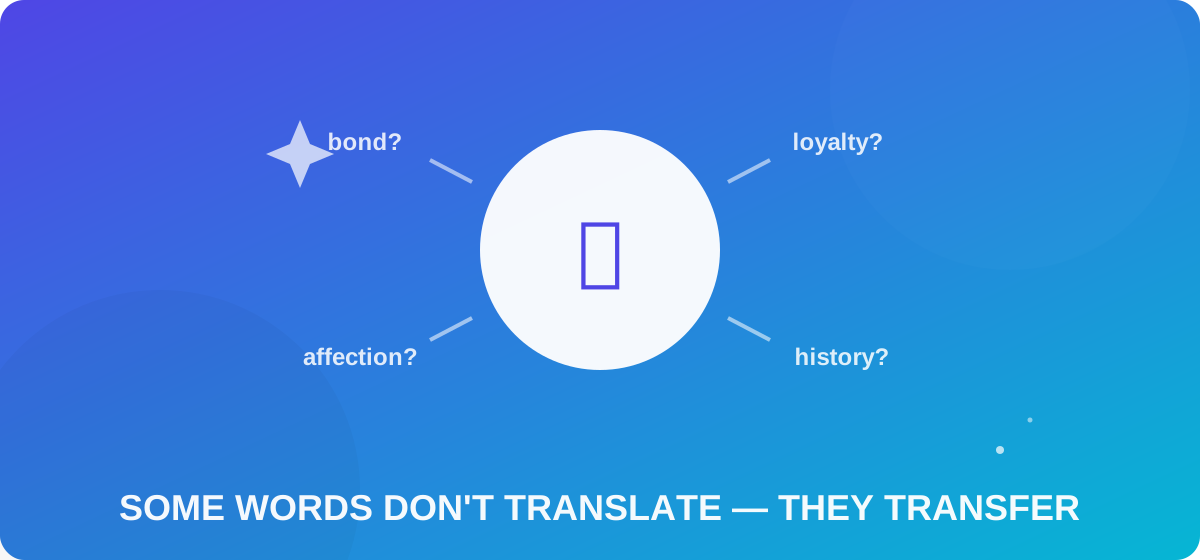
1. 정 (jeong) — the bond that accumulates
The most famous untranslatable. Jeong is the attachment that builds between people (or places, or things) through shared time — part affection, part loyalty, part history. You can have jeong for someone you don’t even like. When a ballad mourns a long relationship, the grief is usually about jeong, not romance — which is why “love” as a translation misses the point.
2. 설렘 (seollem) — the flutter before
That heart-racing, stomach-flipping anticipation right before something exciting — a first date, a bias’s teaser dropping at midnight. “Butterflies” gets close, but seollem is its own noun, and roughly a third of all bright K-pop love songs are entirely about this one feeling.
3. 한 (han) — sorrow with roots
A deep, collective ache — grief, longing, and resilience braided together, often described as something carried rather than felt. It surfaces in K-pop’s most serious work: the ballads and concept albums that reach for something older than heartbreak. Approach this one with respect; entire books argue about what it means.
4. 눈치 (nunchi) — the art of reading the room
Literally “eye-measure”: the ability to sense what others feel and what a situation needs without anyone saying it. In lyrics, having no nunchi makes you the oblivious fool who missed every signal; “reading between the lines” in translated subtitles is often this word doing its job.
5. 애교 (aegyo) — performed sweetness
Fans know this one: the deliberately cute voice, gestures, and expressions idols deploy on variety shows. But it appears inside songs too — a sung line suddenly delivered like a pout is aegyo as a musical technique. English “cuteness” describes the result; aegyo names the performance.
6. 그리움 (geurium) — missing, as a state of being
Not the verb “to miss” but the condition of longing — for a person, a time, a version of yourself. It’s the atmosphere of half of K-pop’s autumn ballads, and the reason “I miss you” subtitles can feel too small for what the vocalist is doing.
7. 답답해 (dapdapae) — the tight-chested feeling
Frustration that sits physically in your chest — stuck, suffocating, unable to say or change the thing. When a singer clutches their shirt mid-ballad, this is the word underneath. English needs “frustrated and helpless and suffocating,” and even that loses the physicality.
Quick Reference
| Word | Rough English | What English loses |
|---|---|---|
| 정 (jeong) | Bond, attachment | That it accumulates over time, and doesn’t require liking someone |
| 설렘 (seollem) | Butterflies | That it’s a noun — a nameable state, not a metaphor |
| 한 (han) | Deep sorrow | The collective, inherited, carried-not-felt quality |
| 눈치 (nunchi) | Social awareness | That it’s a skill you can be good or bad at |
| 애교 (aegyo) | Cuteness | That it’s performed on purpose, as a technique |
| 그리움 (geurium) | Missing someone | That it’s a condition you’re in, not an action you do |
| 답답해 (dapdapae) | Frustrated | The physical tightness in the chest |
Three More Worth Knowing
- 시원하다 (siwonhada) — “refreshing,” but applied to a scalding bowl of soup as readily as a cold drink. It describes relief, not temperature, which is why a literal translation makes it sound like a mistake.
- 아쉽다 (aswipda) — the wistful “ah, if only” of something ending slightly too soon. Not regret, not sadness — the specific ache of almost. It’s all over farewell tracks and encore speeches.
- 심쿵 (simkung) — modern slang, a compound of “heart” and the sound of a thud: the jolt of seeing something overwhelmingly cute or attractive. Newer than the others, and extremely common in fandom language.
How to Hear Them Without Speaking Korean
You don’t need the vocabulary to notice the concepts. A few practical habits:
- Watch where the vocal breaks. Words like geurium and dapdapae are usually delivered with a physical gesture in the voice — a sigh, a tightening, a held breath. The performance is carrying the meaning the subtitle can’t.
- Compare two subtitle sources. Official MV captions and fan translations often diverge exactly at these words, because there’s no single right answer. Where the translations disagree, something untranslatable is usually underneath.
- Notice repeated single words. If a two-syllable word recurs across the chorus, it’s often one of these — Korean lyricists lean on them precisely because they carry so much in so little space.
- Read the title in Korean, not just the English one. Official English titles are frequently marketing rather than translation.
Why This Matters for How You Listen
Translation isn’t failing you — these concepts just live at different addresses in each language. Once you know the seven above, you’ll start noticing when an English subtitle is a summary rather than a translation, and the original vocal delivery (the sigh on geurium, the tightness on dapdapae) starts carrying the meaning the words couldn’t.
That’s the real trick to K-pop lyrics: the language and the performance were never separate things.
FAQ
Are these words really untranslatable? Not literally — everything can be paraphrased. What’s untranslatable is the compression: Korean says in two syllables what English needs a clause for, and lyrics don’t have room for clauses.
Do I need to learn Korean to appreciate K-pop lyrics? No. Knowing that these concepts exist changes how you listen more than vocabulary drills would. Most of the meaning is in the delivery.
Why do fan translations and official subtitles differ so much? Official subtitles optimise for brevity and readability; fan translations often prioritise nuance and add notes. Neither is wrong — they’re solving different problems.
Is han a real linguistic concept or a stereotype? Both, arguably. It’s a genuine word in wide use, but its framing as a defining national emotion is contested by Korean scholars. Treat sweeping claims about it with caution.
What’s the difference between aegyo and just being cute? Aegyo is performed and understood as performance by everyone present. That self-awareness is the whole point, and it’s why it works as a musical device.
Where should I start if I want more? Our everyday K-pop vocabulary guide covers the words that appear in almost every chorus — a more practical starting set than these seven.
More from our Lyrics section: 10 Korean Words You Hear in Every K-Pop Song — and as always, we explain vocabulary and nuance rather than reprinting lyrics.